Friday, 14 September 2012

CREAM IN MY COFFEE (Gavin Millar) [1980]


Here's a delightful film I've been meaning to review for a while but never got round to. I watched this a few months ago alone on a rainy night on a laptop in my bed. It's not how I usually watch films but I was freezing cold. Normally I try to make the experience of watching a film at home as cinematic as possible but for this strange little film, it really didn't matter.

Cream In My Coffee stars Lionel Jeffries and Peggy Ashcroft as an elderly couple visiting a hotel in Eastbourne - the same hotel they visited as a flighty young couple in the 1930s, in secret from their disapproving parents. The film switches between the young couple and the old, highlighting the changes that have occurred since they were there first. The waiters are condescending, the music is terrible, and they don't seem to be enjoying it as much. Maybe that's because they're constantly at each other's throats - Ashcroft's fussing only inflates Jeffries' cantankerous disposition towards everything. He has good reason to be obstreperous and moody, and Ashcroft has even more reason to be fussy, and it's not until later we realise why she has put up with this difficult man for so many years, for her sins - something I won't reveal here.


The film is set almost entirely in the Grand Hotel in Eastbourne. Hotels are wonderful places to set films - they always exist as a sort of dreamy, watchful womb to contain the characters, and more often than not, hotels are portrayed as foreboding, and usually contain ghosts from ages past. Stanley Kubrick's The Shining has probably sprung to mind. These two films were released the same year and would make a great double bill sometime; the similarities, particularly in the denouement of each, are striking.

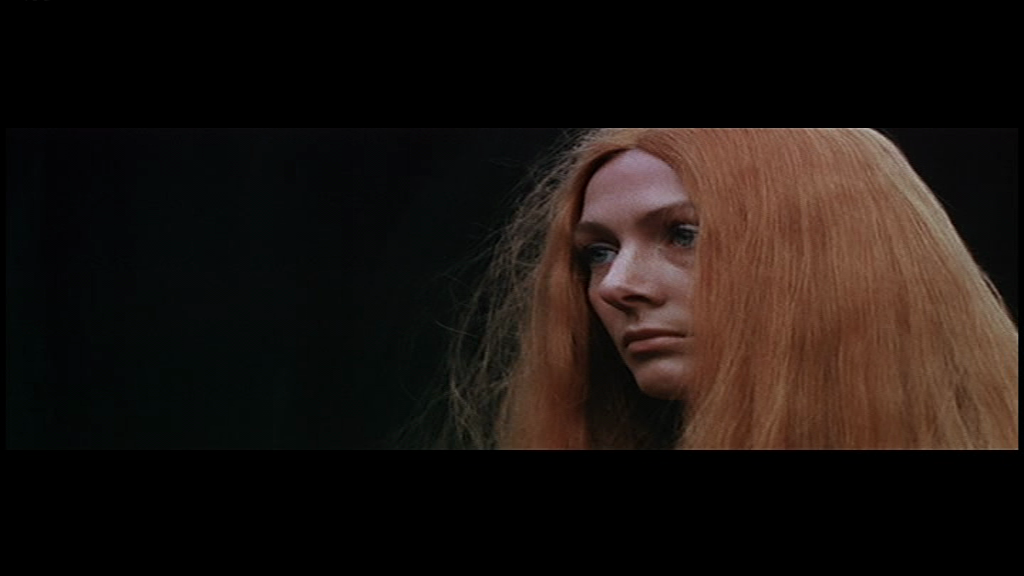
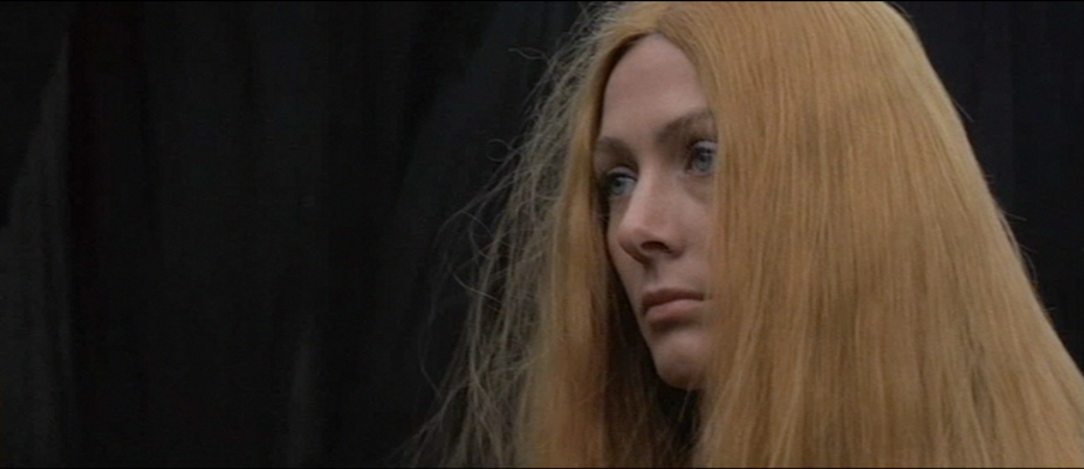
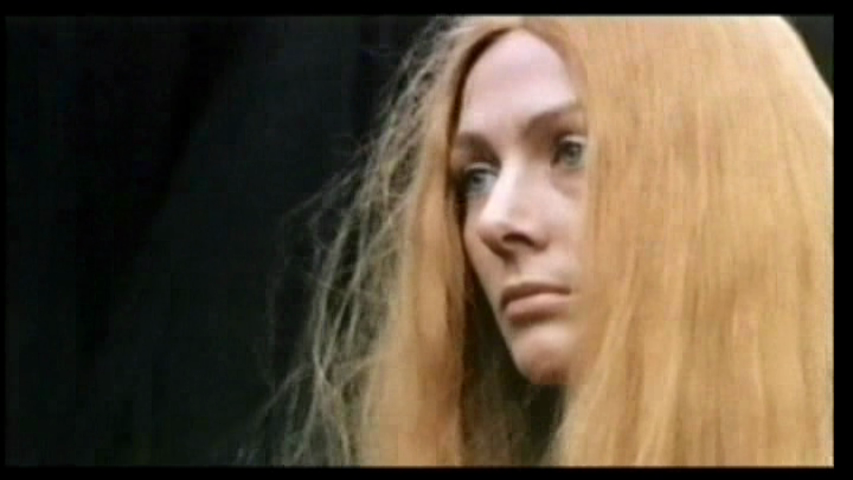
That's not to say this is a horror film. In fact, neither film is really a horror film. But where The Shining plays to the subconcious and makes you feel uncomfortable, Cream In My Coffee is dreamy, nostalgic and mysterious - the sequences from the 1930s are filmed in pastel hues with a very soft focus, as seen below. The hotel is not quite so stylised as Kubrick's classic, particularly in the latter years, but that's very much the point. At times you almost feel as if the hotel is about to close down - there are rarely more than five or six people in the frame until the end.

Throughout the film are a series of seemingly banal encounters, which ultimately mean something to the audience and Jeffries' character in the final moments. There's also a shady nightclub singer - a Dennis Potter archetype - who has a major effect on the outcome of the story, played by Martin Shaw.

It's a dreamy little Sunday evening film which I highly recommend, particularly if you're a fan of Dennis Potter's more well-known fare. It's available on a DVD from LWT and was originally aired on the 2nd November 1980. A bargain with two other great TV plays on it! http://www.amazon.co.uk/Dennis-Potter-London-Weekend-Television/dp/B000AGK0ZE/ref=sr_1_3?ie=UTF8&qid=1347644524&sr=8-3

Saturday, 28 January 2012

VOICE OVER (Christopher Monger) [1981]

Here's an interesting little 'lost' independent gem from Welsh director Christopher Monger available from BFI Flipside. This is an early 80s low budget picture about a radio play writer and broadcaster with a cult following of people who like to laugh and tease him about his Romanticised fantasies. After a reporter cruelly reveals this fact his life changes completely. It's a dark, unsettling, rough-around-the-edges deal which could quite frankly have only been made in a former industrial town in the early 1980s.

At around the same time, a little further up North, Joy Division were making music which could be viewed as the musical counterpart to a film like this. Dark and grimly realistic, full of awkward catharsis and fear.


Fats Bannerman is no Ian Curtis though. His fears are different from Curtis'. His Jane Austen styled radio show is for him an escape into a simpler, more graceful era. Women are coy and frightened creatures, and men are all Captain Suchandsuch and Lord Somebody. When the time comes for some real women to enter his wife, his reaction is a mixture of naive, incongruous, shy and ultimately psychotic. The film was criticised upon its limited original festival release for being a misogynist film. I'm not going into that. Everyone has different opinions on what misogyny is, which parts of the movie apparently convey this notion and whether or not it is deliberate. If it is deliberate then that's fine - it is a film about misogyny - with a character pretending to be a misogynist. I can see however that it could be difficult to defend as McNeice's character is a truly sad and pitiful one. There was something vaguely moving about watching this overweight divorcee move about his shabby flat in his pyjamas that is endearing. We do care for this character.


The sudden presence of a female in his life is not an orthodox one. It gives him a mannequin on which to lay all his Romantic projections. He wants her to be his Elizabeth Bennett. Of course, she's not too keen on this. His descent into a strangely patriarchal, borderline sexual ownership or the unnamed woman is unsettling but still somehow pitiful. He barely ever touches the woman and never has a conversation with her - a breakdown in communication which affects him so badly it leads him to sabotage his own radio play in an unusual and frenzied 'showdown/meltdown'. It's halfway between William Burroughs and Nicolas Roeg. In fact the film reminds me very much of films by the likes of Nic Roeg and Jerzy Skolimowski. The photography is of course not on the same scale, due to the 16mm camera and limited lighting and mobility, but you get what the DP was trying to do.

It's a great little film. And it's now available from BFI Flipside on a great dual format edition, replete with extras. The screenshots above are from the Standard Definition DVD but the blu-ray makes the best of an old scratchy 16mm print.

Monday, 21 November 2011

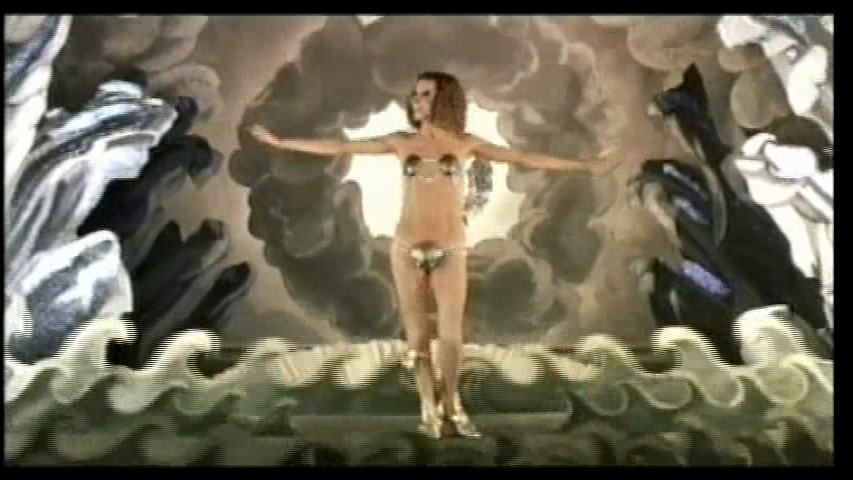
THE DEVILS (Ken Russell) [1971]

This post serves as a comparison for the many versions available of this film. I own most of them. You're probably reading this in the wake of the BFI's announcement of a Region 2 release in 2012. Good news, but most people are incredibly annoyed that it's not the 'uncut' version which people have been craving for years.

Anyone who knows anything about this 1971 Ken Russell movie will know it was hacked to pieces by Warner Brothers US because it was deemed...savage as hell. There is an infamous 'Rape of Christ' sequence. It sounds shocking but in the context of the film it is a key scene. Its omission is a howling blemish on the film.

However, the rest of the film is largely intact whichever way you decide to watch it. There are a few pieces missing here and there but these are practically lost forever. A great shame, but the rest of the film is so good it's worth seeing; at least until the British release in March 2012.

The versions available to the general public at the time of writing are as follows:

The Warner Brothers PAL VHS (late 80s).
The Japanese PAL Laserdisc (late 80s).
The Maverick Directors PAL VHS (late 90s). I own this.
The 'Definitive' NTSC Bootleg DVD (late 2000s, also known as the 'Angel' or 'Euro Cult' DVD). I own this.
The Spanish PAL DVD (2010, legitimate release known as 'Los Demonios'). I own this.
The Korean PAL DVD (2011, questionable legitimacy). I do not own this. I hear it is much the same as the above.
The iTunes Digital Version (2008, 2011). I own this.

Now, to clarify, there are generally two main sources for these releases. I will refer to them as the UK version and US version. The UK version, in PAL format, runs for roughly 107 minutes. The US version is butchered, and is roughly 103 minutes long. The problem comes when deciding what you value more - picture quality, or content. Put simply, if you want content, watch the Maverick Directors VHS. It's sourced from a fairly clean print and is the 'theatrical' UK release - missing only the Rape of Christ and several other 'shocking' scenes. The problem is it is VHS. If you still have a VCR, great. But I find it difficult to watch in the aftermath of High Definition Media.

For quality, you'll want to find the Spanish PAL DVD. It's a great print. Non-anamorphic, unfortunately, but a clean transfer from a theatrical print. The only problem is it is the US version - cut to ribbons, and then some. Several lines of dialogue are cut as well as the visually graphic scenes. Now, for a comparison.

We all know what VHS quality is like. Grainy with obvious horizontal lines due to it being on magnetic tape. This edition is presented in a slightly cropped 1.78:1 aspect ratio.  There is some picture missing from the sides. This is a shame as it has wonderful set design from wonderboy Derek Jarman. I unfortunately am unable to take screenshots of this copy as I have no means of connecting my VCR to my computer. But you get a rough idea of what it would be like.

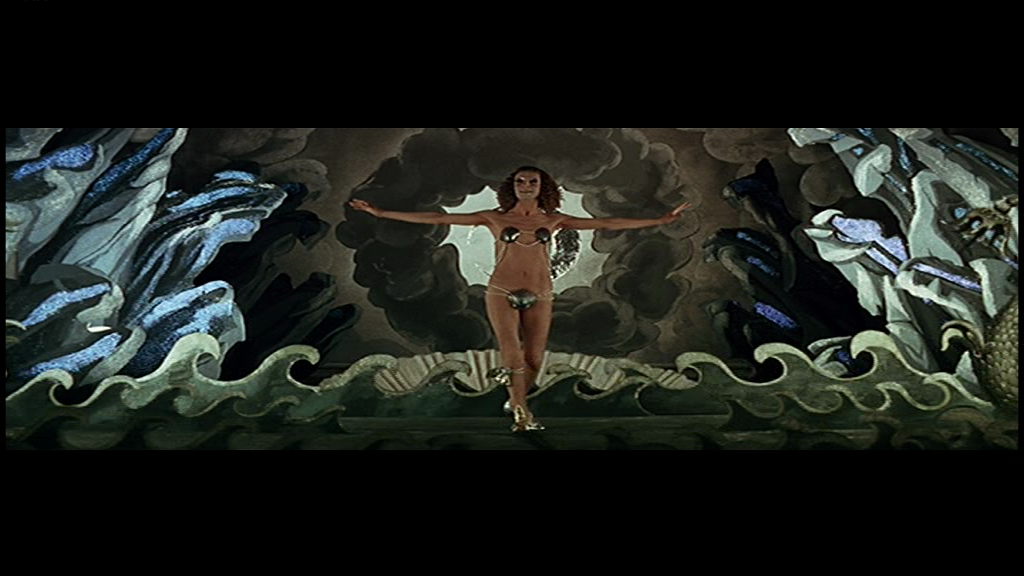
The Bootleg DVD is also cropped to roughly 1.85:1. It is 16x9 anamorphically enhanced. The problem is, it's sourced from the VHS so the quality is roughly the same. The missing footage (which DOES contain the Rape of Christ) is inserted from a PAL TV transmission from the 'Hell on Earth' documentary. Quality is fuzzy but not unwatchable. It appears to have been converted from PAL to NTSC and the usual ghosting artifacts appear. Here:


As you can see, it's poor quality. Not atrocious, and somewhat watchable, but hardly reference quality. Let's compare it with the Spanish DVD:


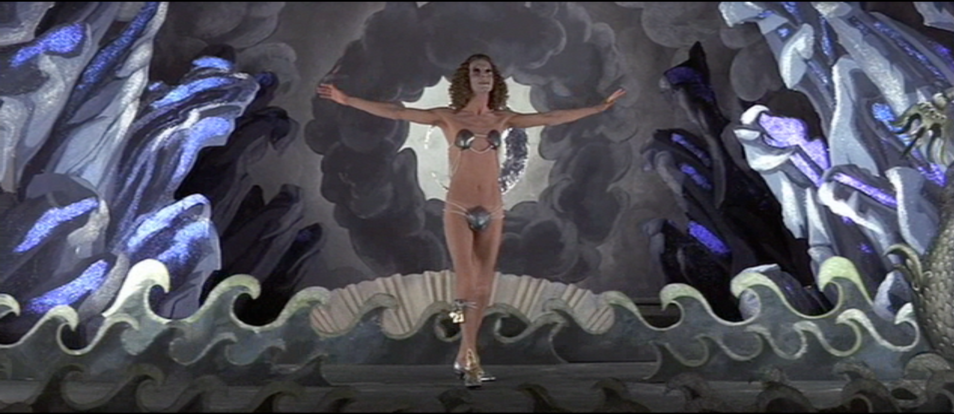
As you can see it is much, much better quality and a massive amount of image data is restored to either side of the screen. Now, those might just look like some cardboard sheets to you, but a hell of a lot of time and craftsmanship went into making those, so they could be proudly displayed in the opening sequence. I am glad I can finally see them there. The iTunes edition is similar. Here:


Slightly lower resolution, but the print is less dark and retains the same amount of information in a 2.35:1 aspect ratio. It looks very good for a 1.4GB video file. Very good. Watching this version was the first time I noticed how well lit many of the interiors are. For example, Spanish:


And the iTunes:


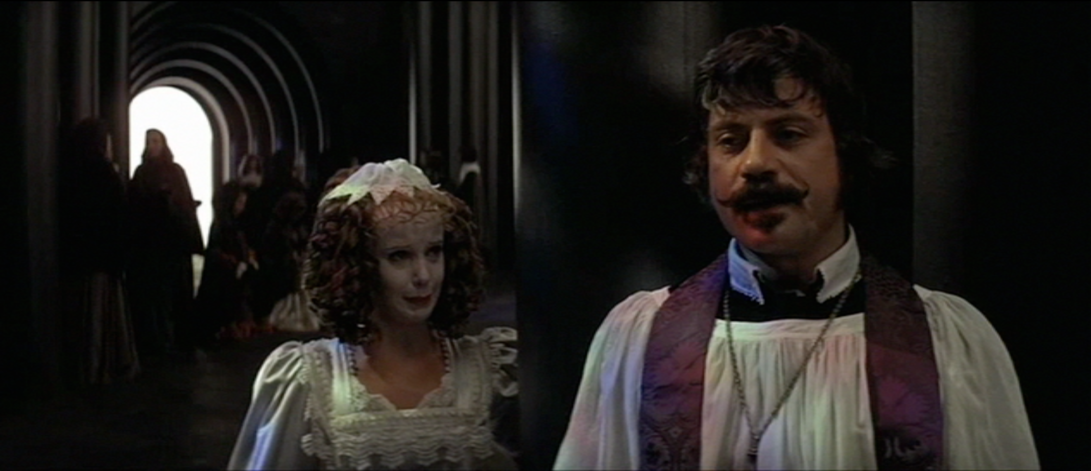
While in this instance the iTunes version appears darker than the Spanish disc (when usually throughout the film it is the other way round), I think this makes it look better. The dappled light falling across Oliver Reed's big manly shoulders looks much better and less like it is coloured in with crayons. A further example. Spanish:


iTunes:


Now, I like redheads, but Vanessa Regrave's hair has a much better tone in the iTunes version; a lot less artificial. It's actually closer to the Bootleg/VHS:

Except sharper and much more on screen.

The final note is that this is an amazing film, one of the finest post-war British films that sits at the top with Kes, Scum, The Servant and Mona Lisa. Warner Brothers' constant disdain for releasing it with reinstated footage is tragic. Still, I would encourage anyone that holds British cinema dear to their heart to track down a copy - preferably the iTunes version, and watch the hell out of it. Or you can wait until March 2012 to see what will hopefully be a beautiful new high-definition visual transfer (albeit not on high-definition medium).

Some related interesting links:


Monday, 27 June 2011

THE MUSIC LOVERS (Ken Russell) [1970]

This film is particularly close to my heart. It's 40 years old and only today - June 27th, 2011, has it got its first release anywhere in the world.

Before this I had a reasonable quality bootleg recorded from VHS. Widescreen with decent sound, but grainy and banding picture quality. This new DVD is quite impressive - strong sound and decent visuals. Not much in the way of remastering though. Here's a comparison:


There are no extras, no subtitles, and the blurb on the back of the box has strange grammar choices. It also says it is 4:3 full frame but the actual picture is 16:9 anamorphic.


I also believe this is the first review of this DVD on the internet. I wonder if anyone else has even bought it?

Sunday, 12 June 2011

DECODER (Muscha) [1984]

Decoder is a really bizarre cyberpunk movie from West Germany. It is notable for starring no real actors, having a new wave soundtrack from the likes of Einsturzende Neubauten and Soft Cell and featuring cameo appearances by counter-culture icons Christiane F., William S. Burroughs and Genesis P-Orridge.


The film is very much based on the writings of William S. Burroughs and those unfamiliar with his writings will find this a little hard to follow. In William S. Burroughs book The Job, he talks of how he shut down a coffee shop by recording the owners' voices on tapes (or something like that) and playing it back in inconveninet times. They went out of business. It's a long time since I've read it, I don't remember exactly! But I do remember him saying the tape recorder is a weapon of the electronic revolution  (play sound effects of riots and fighting and the cops arrive...play the sound of gunshots and their guns are drawn, etc).


The film is lit mostly by neon hues and features some bizarre set pieces, such as a riot breaking out due to unsettling muzak being played in a burger restaurant, a sermon from King (Queen?) of weird Genesis P-Orridge and a woman who really likes frogs (!?) it's pretty strange, but as it has a very short runtime it is quite entertaining.


Availability
I downloaded this from the internet years ago. It was a pretty shoddy VHS Rip (I think) with white lines at the sides where the frame didn't fill the whole picture and the back of the telecine is visible. This lends the film a real bootleg quality to it - as if the video itself is a tool for revolution. Finding it was near impossible as it was only released in Germany until last year when it got a DVD release.
I have not had the chance to check out the DVD and the screens above are from my downloaded copy.

BARFLY (Barbet Schroeder) [1987]

Being a big Mickey Rourke fan it is no surprise I should write about one of his lesser-known roles. It's also interesting to see the two biggest adverts for bad plastic surgery together in one movie! They both ruined their beautiful faces with surgery, and this movie offers a glimpse of what they would become!


Barfly is a biography of Charles Bukowski, alcoholic and author. It is considered by fans of Bukowski to be a much better film than the recent Factotum starring Matt Dillon (who previously appeared with Mickey Rourke in Rumble Fish) and a much more accurate one. It also starts Jack Nance as an eccentric private detective.


Down-and-out Rourke meets down-and-out Dunaway in the bar and they go drinking together. That's it! That's the movie! Actually it's not - a strange love triangle begins involving a pretentious publisher who mistakes the protagonists occasional inane scrawlings for something much more didactic. Rourke gets into a lot of fights, sleeps on the streets, rows with his girlfriend (who herself is having an affair) and by the time it's over the characters have gone back to their same old ways...it's the journey that matters in this film.


Availability
There's a blu-ray available on Amazon for a not inconsiderable sum as well as several overpriced out of print Region 2 DVDs. I've also seen it in a double bill pack with The Pope of Greenwich Village, another Rourke film.

BENT (Sean Mathias) [1998]

Here's an interesting one. I'm a bit of a fan of Clive Owen as he has appeared in several of my favourite films. I hadn't heard of this one. Then I saw a picture of Clive Owen with no hair!


Bent is a gay interest film set in World War II. A young homosexual playboy gets caught up in the Night of the Long Knives after a night with a gay SA soldier. As the soldier is slaughtered in front of him he escapes to visit Ian McKellen, his gay uncle, and along the way also meets Mick Jagger playing a drag queen, in a nice little cameo. Eventually he is caught by the Nazis and sent to a concentration camp. In a gruelling scene, a man is beaten to death in front of him for no reason. He befriends a young Jew, and in order to remain with him chooses a yellow star instead of a pink triangle, thus identifying him as Jewish and not gay. Apparently, the treatment of gays was (hypocritically) far worse. There is a bit of debate about how much he values his identity but really he just does this to remain with his new found friend.


It is pretty overwrought, as many films which are adapted from stage plays are. But there are some fine moments, and the cramped relationship between the two men grows in the subtlest of ways. Tasked with moving stones all day, they manage only fleeting moments to talk to each other but when they do it is emotionally charged. There is one horribly embarrassing scene in which they are talking to each other, with eyes closed, very sexually, and eventually it is implied they simultaneously ejaculate without touching each other. It was difficult to view, and not because it was homosexual but because it was ridiculous!


It's mostly very well acted - Clive Owen has come under fire for his acting style, but it sort of appeals to me. He is best at acting when he's not saying anything. This worked well for his role in Croupier (my favourite film) and as the smouldering Dwayne in Sin City. The SS officers are portrayed well - speaking in cold, horrid curt tones and not coming off as too rabid or cartoon-like. This film apparently won a special prize at Cannes, but according to IMDb the director Sean Mathias never made another film, and is primarily an actor. He was also a long-term partner of Ian McKellen!

Availability
I ordered this film from a South Korean vendor on eBay - it was cheap and had free postage. Took a while to arrive but that is to be expected. Of course, about a week later a Dual Format Blu Ray/DVD appeared in the UK. Never mind! My Korean edition is a sound package - with a nice cardboard slipcase and a Region Free NTSC disc with excellent print quality. I would probably recommend this over the expensive Blu Ray.